Steel Retaining Wall Ideas: How to Use Steel in Modern Garden Design
Steel retaining walls have become an increasingly popular feature in contemporary garden design. Their slim profile, clean lines and choice of finishes make them particularly effective when creating raised beds, terraces and level changes without the visual bulk of traditional masonry walls.
But a successful steel retaining wall is about more than choosing the material. Its position, height, finish, planting and relationship with the rest of the garden all contribute to the finished result.
If you're considering steel retaining walls for your garden, here are some of the best ways to incorporate them into your landscape.
1. Use Steel Retaining Walls to Terrace a Sloped Garden
One of the most practical uses for a retaining wall is transforming a sloping garden into usable, level spaces.
Rather than treating a slope as one large incline, retaining walls can divide it into a series of terraces. These new levels can then become:
- Lawns
- Patios and dining areas
- Raised planting beds
- Outdoor kitchens
- Children's play areas
- Paths and steps
- Seating areas
Steel works particularly well for garden terracing because its relatively slim profile allows you to maximise the usable area on each level.
This can be particularly valuable in smaller gardens where losing several hundred millimetres to a bulky traditional wall can make a noticeable difference.
2. Choose a Finish That Complements the Property
The finish of your steel retaining wall can dramatically change the character of the garden.
Corten Steel
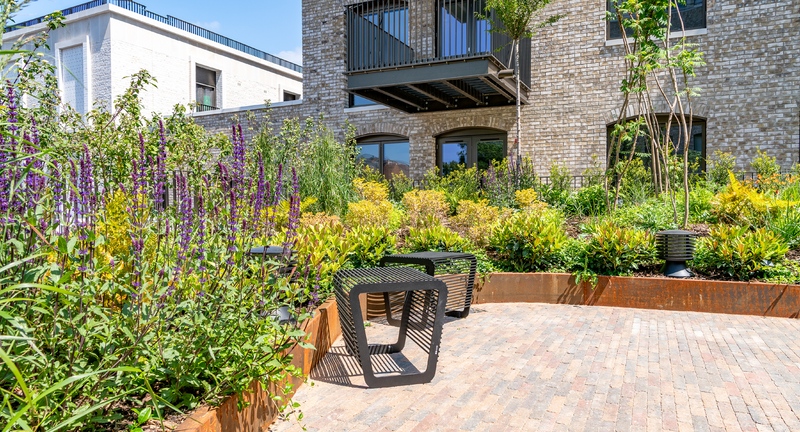
Corten develops its distinctive orange-brown weathered patina over time.
It works particularly well alongside:
- Natural stone
- Gravel
- Timber
- Ornamental grasses
- Contemporary planting
- Brick architecture
The warm colour provides contrast against green planting without feeling overly manufactured.
Powder-Coated Steel
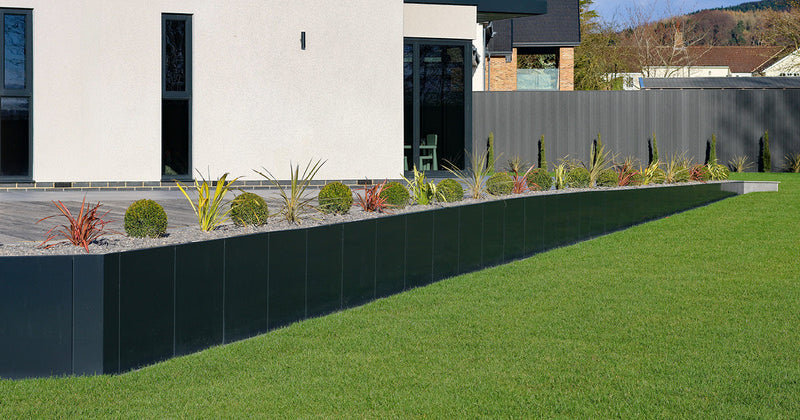
For contemporary gardens, powder-coated steel retaining walls provide a much cleaner architectural appearance.
Black and anthracite finishes are particularly effective alongside modern windows, porcelain paving and darker architectural detailing.
Alternatively, powder coating allows the retaining wall to become part of the garden's colour palette rather than simply a structural element.
Stainless Steel
Stainless steel provides a very different aesthetic.
Its clean metallic appearance suits highly contemporary landscapes and projects where exceptional corrosion resistance is required.
3. Combine Retaining Walls with Raised Planting
A retaining wall doesn't have to feel like an engineering feature.
Planting above and around the wall can transform it into one of the most attractive parts of the garden.
Consider plants that soften the transition between steel and landscape, including:
- Ornamental grasses
- Ferns
- Lavender
- Evergreen shrubs
- Perennials
- Trailing plants
Allowing selected plants to cascade slightly over the retaining edge can create a particularly effective contrast between precise steel detailing and natural planting.
The wall provides structure. The planting provides softness.
Together, they create a much more balanced landscape.
4. Use Retaining Walls to Create Defined Garden Zones
Modern gardens increasingly need to perform several functions within the same space.
One garden might need to accommodate dining, entertaining, planting, children's play and relaxation.
Changes in level can help separate these areas without physically enclosing them.
For example, you could create:
Upper terrace: outdoor kitchen and dining.
Middle terrace: lawn and entertaining space.
Lower terrace: planting or a secluded seating area.
Steel retaining walls create a strong visual boundary between each level while allowing the overall garden to remain open.
This is particularly effective where you want to create garden rooms without installing fences or screens.
5. Incorporate Steps Into Your Retaining Wall Design
Where there are retaining walls, there will often be changes in level that require steps.
Rather than treating the steps as an afterthought, make them part of the overall composition.
Steel can be used to create strong lines alongside:
- Porcelain steps
- Gravel
- Natural stone
- Resin-bound surfaces
- Timber
- Concrete
Repeating the same steel finish throughout the garden helps connect different areas visually.
A Corten retaining wall, for example, can be complemented by Corten edging around nearby paths or planting beds.
6. Add Lighting to Steel Retaining Walls
Landscape lighting can completely change the appearance of a retaining wall after dark.
Rather than flooding the entire garden with light, subtle lighting can emphasise the shape and texture of the wall.
Options include lighting:
- Beneath the top edge
- Along pathways beside the wall
- Within planting above the wall
- At the base to wash light upwards
- Around steps and level changes
Lighting is particularly effective with textured planting because shadows create additional depth after sunset.
It also makes changes in level easier to identify at night.
7. Keep the Design Simple
One of steel's biggest advantages is its simplicity.
You don't necessarily need elaborate detailing to create impact.
A long, uninterrupted steel retaining wall running through planting can become a strong architectural feature in its own right.
In many contemporary gardens, the most successful approach is to use a restricted palette of materials.
For example:
Corten + gravel + natural stone + planting
or
Black steel + pale porcelain + lawn + evergreen planting
Repeating these materials throughout the landscape creates cohesion and prevents the garden from becoming visually cluttered.
8. Don't Forget Drainage
Although appearance is important, a retaining wall ultimately has a structural job to perform.
Water accumulating behind a wall creates hydrostatic pressure, so appropriate drainage should form part of the design from the beginning.
Depending on the application, this may involve free-draining backfill, drainage pipes, gravel or other drainage provisions.
Higher retaining walls also require considerably more structural consideration than simple garden edging.
The system should always be appropriate for the height, ground conditions and loads it is expected to retain.
Which GEO Steel System Should I Use?
The right system depends largely on the height and purpose of the edge.
Groundline
Designed for 50–150mm garden edging.
Ideal for defining lawns, gravel, paths and planting areas where significant soil retention isn't required.
Contour
Designed for 200–600mm raised beds and taller garden edges.
Contour is particularly useful where a garden design incorporates both straight and curved sections.
Anco
Designed for 300–1200mm retaining applications.
For significant level changes where structural performance becomes critical, Anco is GEO's dedicated steel retaining wall system.
Available in finishes including Corten steel, stainless steel and powder-coated options, it allows the retaining structure to become an intentional part of the garden design.
Are Steel Retaining Walls Right for Your Garden?
Steel retaining walls are particularly effective when you want to combine structural performance with contemporary garden design.
They can help turn difficult slopes into usable terraces, introduce raised planting, define different areas and create clean architectural lines throughout a landscape.
Most importantly, steel doesn't need to look like a structural necessity.
Specified correctly, the retaining wall can become one of the features that defines the entire garden.
Whether you prefer the evolving character of Corten steel, the contemporary appearance of powder-coated steel or the clean finish of stainless steel, the material can be selected to complement both the property and landscape.
Planning a Steel Retaining Wall?
If you're designing a sloped garden, creating terraces or looking for a cleaner alternative to timber, brick or block retaining walls, explore the GEO Anco steel retaining wall system.
For lower raised beds and garden level changes, our Contour system provides another flexible solution.
Explore GEO steel retaining walls and raised beds, or contact our team for help choosing the right system, height and finish for your project.